What's the benefit of joining a locally owned brokerage in Daybreak? At a locally owned brokerage, the person who can approve your idea works in the same building you do, so decisions land in days instead of quarters. Zander Real Estate is headquartered on Daybreak Parkway, inside the community it sells. For agents who live nearby, that proximity cuts hours of weekly driving and turns everyday errands into prospecting.
What do agents forget to ask in a recruiting meeting?
Agents ask about splits, caps, and lead flow. Reasonable questions, all of them.
Almost nobody asks the two questions that shape the actual day: who owns this company, and how far am I driving?
Both matter more than they sound like they do. One determines whether anyone can say yes to you. The other determines how many hours a week you spend looking at a windshield instead of a client.
Zander Real Estate is a locally owned brokerage in Daybreak. The office sits at 4709 S Daybreak Parkway, inside the community it serves. Here's why that combination changes the job.
[IMAGE: 01-two-questions.png] Alt text: Two questions agents should ask before switching brokerages: who owns the company and how far is the commute
What does "locally owned" actually mean day to day?
Independent and franchise brokerages both close houses. The difference shows up in how fast things move and who gets to decide.
Decisions happen in the building. You want to try a new farming approach in a specific Village, run a different open house format, or spend marketing dollars on a neighborhood mailer instead of a portal. At a locally owned brokerage, that's a conversation with the owner, and you get an answer the same week. At a franchise, some of those calls are made by people who have never driven Daybreak Parkway.
The marketing is built for this market, not adapted to it. National templates are designed to work everywhere, which means they are specific to nowhere. A brokerage that only operates here can build materials that reference Oquirrh Lake, the village structure, and how buyers here actually search, because it has no other market to serve.
No franchise fee sits between you and the business. Franchise brokerages route a percentage off the top to the parent company. That money buys real things, brand recognition and a national referral network among them. It also means a slice of every closing leaves the local economy. At an independent, the money spent on your business stays in the business.
The broker is reachable. Not "has an open door policy." Reachable. Same building, same market, same day, when a deal is falling apart at 4:45 on a Friday.
Independent or franchise: what is the real difference?
Locally owned independent National franchise
Who approves a new idea: The owner, in the same building Often corporate, out of state
Typical turnaround on that answer: Same week Depends on the layers above you
Marketing materials: Built for Daybreak specifically National templates adapted
Franchise fee off the top: None A percentage of every closing
Brand recognition: Earned locally over time Instant and national
Relocation referral network: Smaller distribution groups Hundreds of agents come first
Geographic range: Deep in one corridor Broad across markets
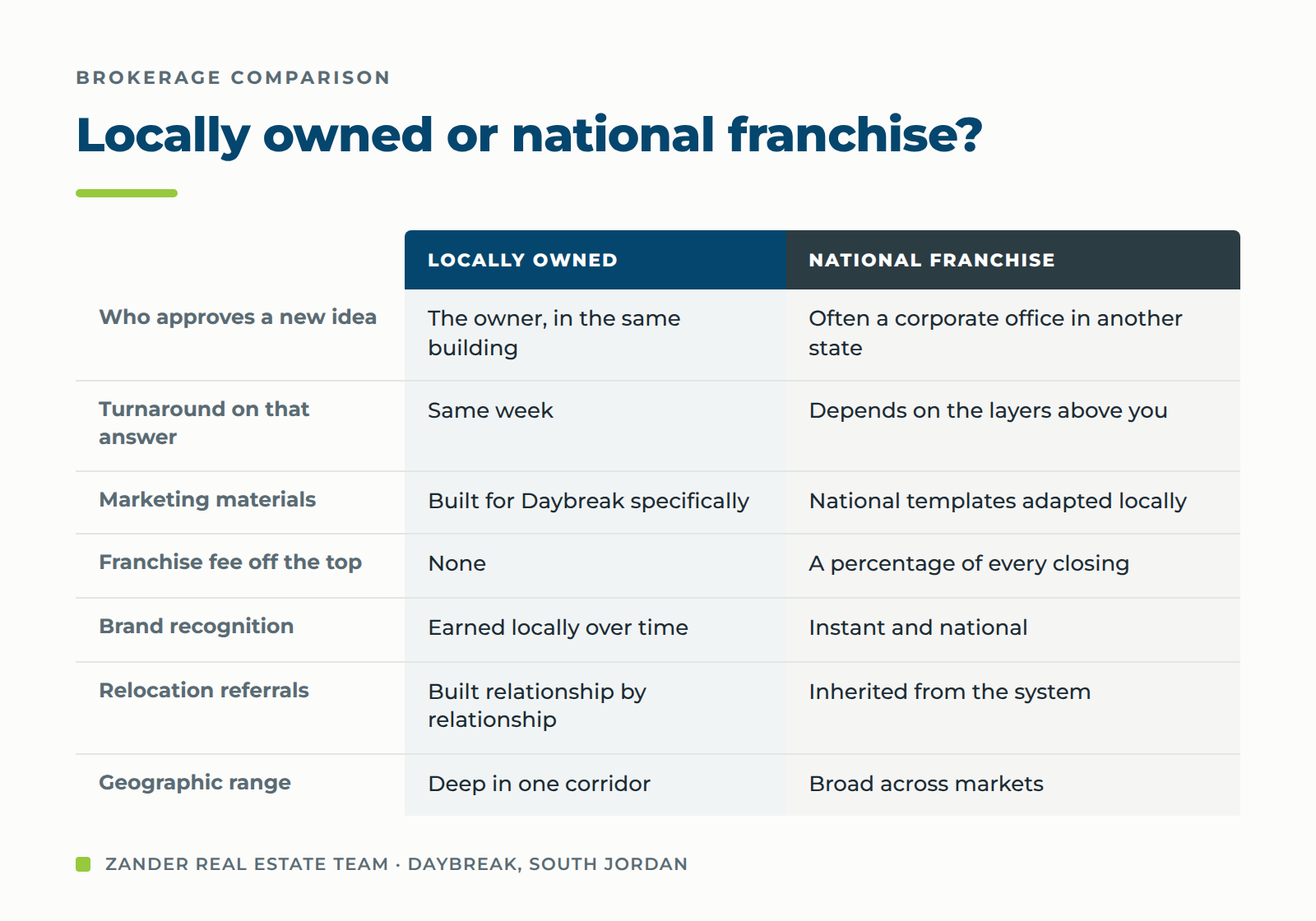
Neither column is the right answer for everyone. It depends on whether your business plan is concentrated or spread out.
How much is your commute actually costing you?
This is the part agents underestimate until they've lived both versions.
Windshield time is the hidden tax on your income. Run your own numbers. Here's the math on ten showings and appointments a week, across 48 working weeks:
8 minutes each way 25 minutes each way
Hours in the car per week: 2 hours 40 minutes 8 hours 20 minutes
Hours per year: 128 400
Equivalent 40-hour weeks: 3.2 10
The difference is 272 hours a year, close to seven full working weeks. Not spent prospecting. Not spent with clients. Not spent at home.
You're already standing in your farm. When you live and work in the same community, prospecting stops being a separate activity you schedule. It's the trail loop, the grocery run, the line at a SoDa Row restaurant, the Saturday morning game. Every errand is a touch. Agents who commute in have to manufacture that presence. You just have it.
Speed wins listings. A seller calls at 10 a.m. wanting to know what their home is worth. The agent who can be standing in the kitchen by 10:20 has a structural advantage over the one who's 30 minutes out and books for Thursday. In a community as tightly connected as Daybreak, that responsiveness gets talked about.
And you're home for dinner. Real estate will take every hour you let it. Working eight minutes from your house is one of the few structural defenses against that.
Why does local plus team beat local plus solo?
Working close to home solves geography. It doesn't solve capacity.
The 2026 NAR Member Profile reports that the typical Realtor closed nine transaction sides in 2025. Agents at team-based brokerages reported a median of 32. Only 21% of Realtors work on a team at all.
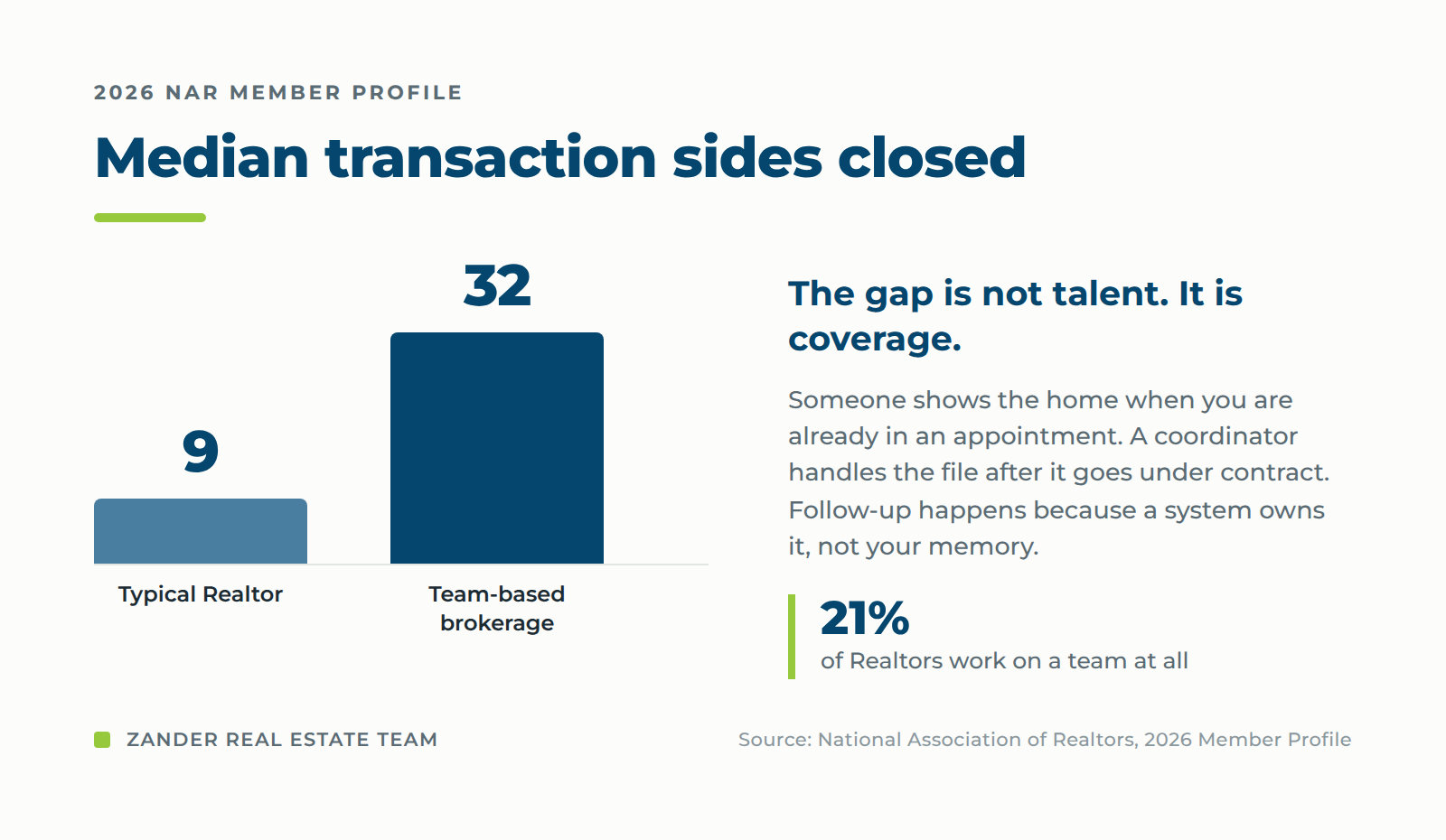
That gap isn't talent. It's coverage. On a team, someone can show a home when you're already in an appointment. A transaction coordinator handles the paperwork after you go under contract. The follow-up on a lead that went quiet four months ago actually happens, because a system owns it instead of your memory.
Local proximity plus team structure is the combination. Proximity gives you the hours back. The team makes sure those hours go into revenue instead of admin.
What does living where you sell do for your business?
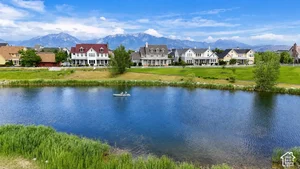
Daybreak is a master-planned community with a shared trail network, a lake, a downtown district, and a full events calendar. The same people cross paths constantly. That means reputation travels faster here than in a scattered suburban territory, in both directions.
An agent who lives in the community isn't building a client list. They're building a standing. The people who refer you are the ones you'll see at the lake next weekend, which is a form of accountability that no compliance policy can replicate.
For the Zander Real Estate Team, roughly half of all business now comes from repeat clients and referrals, alongside more than 450 five-star reviews and three agents ranked in the top 500 on the Wasatch Front.
What do you give up at an independent brokerage?
A locally owned brokerage isn't strictly better on every axis, and it's worth knowing what you're trading.
Name recognition. National brands come with instant recognition. An independent has to earn it locally, which takes longer but tends to stick harder.
A national referral network. Franchise systems route relocation and out-of-state referrals internally. Independents build referral relationships deliberately instead of inheriting them.
Geographic range. A brokerage rooted in Daybreak is built for Daybreak, South Jordan, and the surrounding corridor. If your plan is to work Utah County and Davis County too, that's a real consideration.
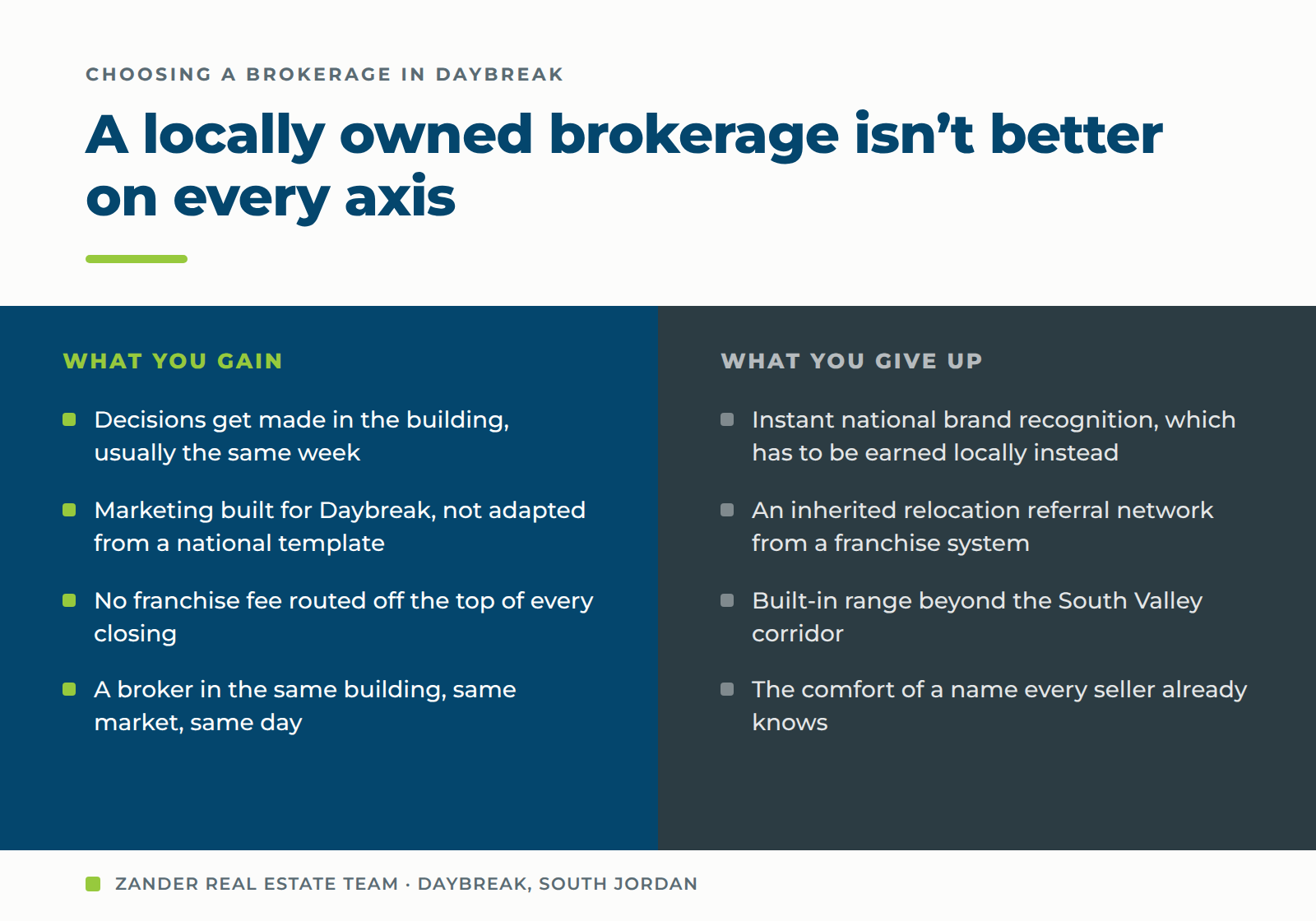
If those tradeoffs are dealbreakers for your business plan, a franchise may fit you better. That's a legitimate answer, and it's better to figure it out before you move than after.
Frequently Asked Questions
Is an independent brokerage as good as a national franchise? For most agents working a defined local market, yes, and often better. You trade national brand recognition and a built-in relocation referral network for faster decisions, local marketing, and direct access to the owner. If your business is concentrated in one community, the local advantages generally outweigh the brand.
Do I have to live in Daybreak to work at a Daybreak brokerage? No. But agents who live in the community they sell tend to build faster, because their everyday routine puts them in front of clients and neighbors without scheduling it. Proximity is an advantage whether you're inside the community or a few minutes from it.
What does it mean to operate as a team? It means coverage and shared systems rather than everyone running a solo business under one roof. Showings get covered, a transaction coordinator handles files after they go under contract, lead follow-up is systematized, and the marketing is built once for everyone instead of rebuilt by each agent.
Does a locally owned brokerage pay better than a franchise? The split is only part of the answer. Independents don't route a franchise fee off the top, but the more meaningful difference is usually volume: what you net depends more on how many sides you close with the support behind you than on the percentage itself. Compare projected income, not percentages.
How hard is it to move my license to a different brokerage in Utah? It's an administrative change, not a re-licensing process. The Utah Division of Real Estate handles the affiliation transfer, and most agents complete it in days. The bigger question is timing around pending transactions, which is worth walking through before you give notice.
Ready to see it in person?
If you're a licensed agent in Daybreak, South Jordan, or nearby, the easiest way to evaluate this is to come by the office on Daybreak Parkway and see how the Zander Real Estate Team actually runs. No pitch, no pressure, just a straight conversation about whether it fits what you're building.
Book 30 minutes on my calendar, or call (435) 249-7917.
About the author
Ben Zander is Growth and Development Manager at the Zander Real Estate Team in South Jordan, Utah. He works with agents across Daybreak, South Jordan, and the southwest Salt Lake County corridor on business development, marketing, and growth. He has two Master’s degrees in People and Business and has worked for startup companies to Fortune 500; and is here to support you.
Office: 4709 S Daybreak Parkway, Suite F, South Jordan, UT 84009.
Contact: 435-249-7917 | b.zander@zanderteam.com