Does living near a bus rapid transit line increase your home's value? Yes. Research consistently shows that BRT and light rail proximity adds 5–15% to nearby home values, and the southwest Salt Lake Valley just got its first real transit connection with the April 2026 launch of the Midvalley Express.
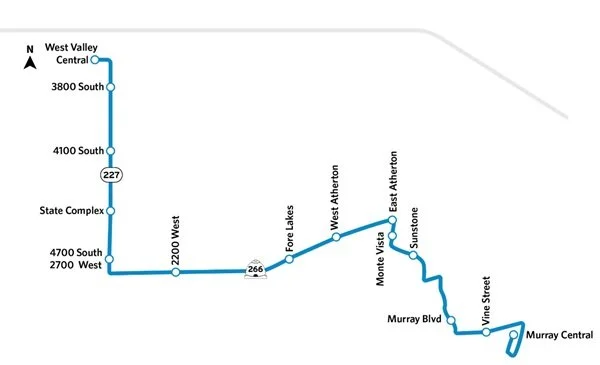
The southwest Salt Lake Valley has always had one knock against it: you needed a car for everything. That's changing. On April 12, 2026, the Utah Transit Authority launched the Midvalley Express (MVX), a 7-mile, all-electric bus rapid transit line running every 15 minutes between Murray Central Station and West Valley Central Station. It passes through Taylorsville and Salt Lake Community College. And for at least the next three years, it's completely free to ride.
For anyone buying, selling, or already living in Daybreak or South Jordan, this is worth paying attention to. Transit access is one of those infrastructure upgrades that tends to move home values quietly, then all at once.
What Is the Midvalley Express?
The MVX isn't a regular bus. Bus rapid transit (BRT) operates more like light rail: dedicated lanes, real-time arrival information, level boarding, and consistent 15-minute headways throughout the day. UTA built this one specifically to address a long-standing gap in southwest Salt Lake County, where residents between West Valley City and South Jordan had limited transit options.
The route spans 15 stops over 7 miles, connecting:
Murray Central Station (a major TRAX hub with connections downtown and to the airport)
Salt Lake Community College in Taylorsville
West Valley Central Station
Total project cost came in at $109.6 million, with significant federal funding — including a $62.8 million federal grant — and it was delivered ahead of schedule and under budget.
It's UTA's third BRT line in the state, following the Ogden Express and the Utah Valley Express (UVX) in Provo-Orem, which has been transformative for walkable development along its corridor.
Why This Matters for Daybreak and South Jordan
Daybreak in South Jordan (ZIP 84009) already has TRAX's Red Line running through it, connecting residents to downtown Salt Lake in under 40 minutes. The MVX doesn't run directly through Daybreak, but it extends the transit web in a way that matters to buyers evaluating the southwest valley as a whole.
Here's the practical impact:
More buyers qualify for the area. Not every buyer wants or needs two cars. Young professionals, single-income households, and relocators from transit-heavy cities often filter out car-dependent neighborhoods before they even look at listings. A more connected southwest valley expands the buyer pool for Daybreak homes.
Connectivity compounds. MVX feeds into Murray Central, which feeds into TRAX, which reaches the airport, the University of Utah, and downtown Salt Lake. The southwest valley is no longer a transit dead end. That story has changed, and buyers who follow infrastructure know it.
Comps in transit corridors tend to outperform. A 2013 American Public Transportation Association study found that homes within a half mile of high-frequency transit outperformed comparable markets by an average of 41.6% over a 5-year period. BRT specifically has shown 5–15% value premiums in corridors where service is reliable and frequent. The MVX checks both boxes.
It signals what's coming. FrontRunner 2X — the project that doubles commuter rail capacity along the Wasatch Front — has begun construction, with completion targeted for 2030. The Point infill station south of Draper is also in the pipeline. This isn't a moment; it's a trend line.
If you've been on the fence about Daybreak or South Jordan because you wanted a more connected lifestyle, this changes the picture. The TRAX Red Line already serves Daybreak directly. Combined with the MVX link to the broader Salt Lake network, the southwest valley is building the kind of transit infrastructure that buyers in Portland, Denver, and Phoenix paid a premium to live near — before those corridors matured.
FAQ
Does the Midvalley Express serve Daybreak directly? Not directly. The MVX runs between Murray Central and West Valley Central through Taylorsville. However, it extends the connected transit network in the southwest Salt Lake Valley. Daybreak is already served by the TRAX Red Line, and the two systems connect through the broader UTA network.
Does living near transit actually increase home values in Utah? Research supports it. Studies on transit-adjacent home values consistently show a 5–15% premium for BRT corridors and higher for light rail. In Utah, the TRAX corridors in Salt Lake City and the UVX corridor in Utah County have both seen increased development and buyer demand since launch.
Is Daybreak, South Jordan a good place to buy in 2026? For buyers who want a master-planned community with amenities, parks, and now an expanding transit network, Daybreak remains one of the most compelling value propositions in Salt Lake County. Median prices are up year-over-year, inventory is slowly improving, and infrastructure investment in the area continues. It's worth a serious look.
The Zander Real Estate Team can walk you through current comps and buyer demand in your neighborhood. Call us at 801-446-2662 or reach out at zanderteam.com.
We're here when you're ready to make your move.