Is it better to buy a house in 2026 or 2027?
For most Utah buyers who are financially ready and plan to stay five years or more, buying in late 2026 looks better than waiting for 2027. Mortgage rates sit around 7% after the Fed's September 2026 rate hike, and major forecasters (Fannie Mae and the Mortgage Bankers Association) expect them to stay in the high-6% range through 2027, not drop sharply. Meanwhile, Utah homes are taking about 65 days to sell and sales are down double digits, which gives buyers real negotiating power right now. Waiting mostly means paying another year of rent for a rate that's forecast to be only slightly lower, and have little impact in the long run.
Everyone wants to time the market. Buy at the bottom, lock the lowest rate, and never look back.
Here's the problem: in 2026, "waiting for rates to drop" is a plan built on a forecast nobody is actually making.
This is one of the most common questions we're hearing from buyers in South Jordan, Daybreak, and across Utah County right now. So let's look at what's really happening — rates, prices, and leverage — and what it means for your decision.
What's Happening With Rates, Prices, and Inventory Right Now
Mortgage rates: higher, and expected to stay that way
On September 16, 2026, the Federal Reserve raised its benchmark rate by a quarter point and signaled one or two more hikes through 2027. Mortgage rates followed. Freddie Mac's 30-year fixed average hit 7.03% the week of September 24 — up from 6.30% a year earlier.
What about 2027? Here's what the two biggest mortgage forecasters said in late September:
Fannie Mae: about 6.7% for 2027
Mortgage Bankers Association: about 6.8% through the first half of 2027, with rates staying "near current levels"
That's a difference of roughly a quarter to a third of a point. Not the 5% rates buyers keep hoping for.
Utah home prices: flat, not falling
If you're waiting for a price crash, the data isn't cooperating. According to Utah Association of REALTORS® data for August 2026:
Salt Lake County: median sale price about $555,000, roughly flat year over year
Utah County: median sale price about $524,000, up 4.3%
Statewide: about $525,000, down just 0.4%
Utah's long-running housing shortage keeps a floor under prices. Buyers stepped back — prices mostly didn't.
Inventory and leverage: this is the opportunity
Here's the part most buyers miss. While prices held, activity dropped hard:
Statewide closed sales fell 13.5% in August, and pending sales dropped 21.6%
Homes are taking about 65 days to sell statewide
More than 15,000 active listings are on the market across Utah
Fewer buyers plus more listings sitting longer means sellers are negotiating. That's where your real savings live in 2026 — not in the rate you might get next year.
What Waiting Until 2027 Actually Costs You
Let's run the numbers on a $600,000 home in South Jordan with 10% down ($540,000 loan). Principal and interest only:
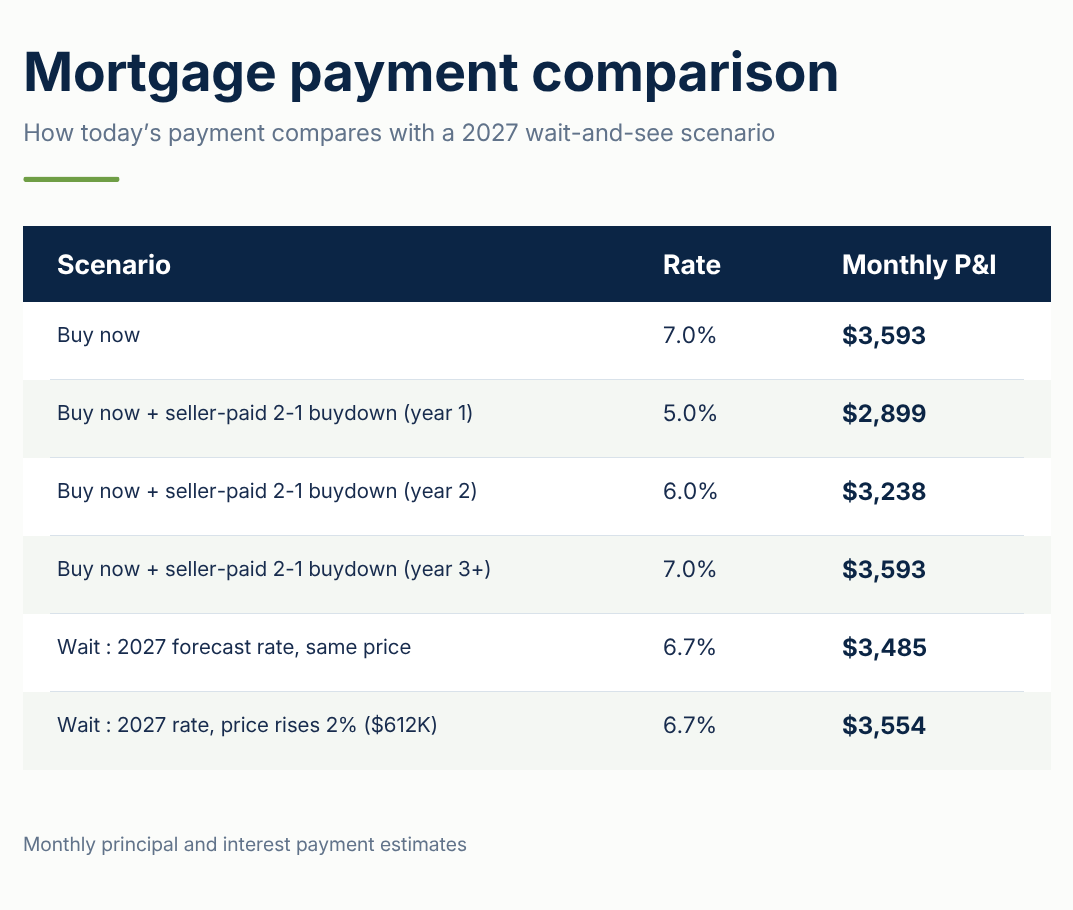
If you wait a year and the forecasts are right, you save about $40–$110 a month. To get there, you pay 12 more months of rent, and you don't build a dollar of equity in the meantime.
Now look at the rows 2-4. With a seller-paid buydown, your payment for the first two years is lower than any "wait" scenario by as much as $586 a month in year one.
The better move: negotiate your rate down now
Remember that leverage? Here's how buyers are using it.
In the REPC, you can ask the seller to cover part of your closing costs — including a temporary rate buydown. A 2-1 buydown drops your rate 2 points in year one and 1 point in year two, then settles at your full note rate in year three — the payments in the table above.
The cost of that buydown is roughly $12,500 — about 2% of the price, well within the concession limits on a conventional loan with 10% down. On a listing that's been sitting for 60+ days, that's a very realistic ask.
Here's the honest trade-off: in year three, your payment returns to 7.0% — about $108 a month more than a buyer who waited and got 6.7%. But you'll have saved roughly $10,000 in payments over the first two years, plus a year of rent and two-plus years of equity. It would take the waiting buyer about eight years just to catch up on the payment savings alone. And if rates do fall later, refinancing is always on the table (though you shouldn't buy counting on it).
Every deal is different, and what a seller will agree to depends on the home, the price point, and how long it's been listed. That's exactly the kind of strategy we build into offers for our buyers — and it's where a local agent earns their keep.
Don't forget the cash side, either. Our breakdown of Utah buyer closing costs walks through what you'll bring to the table, and if you're looking in Daybreak, factor in Daybreak HOA fees too.
When Waiting Until 2027 Makes Sense
Buying now isn't right for everyone. Waiting is the smarter call if:
You'll likely move within 3–5 years. Closing costs and selling costs can eat any appreciation on a short hold.
Your income isn't stable yet. New job, commission-heavy role, or a business in its first year — lenders and your stress level both prefer a track record.
You'd drain your savings to close. Plan to keep 3–6 months of expenses in reserve after moving in.
Your credit needs work. A 60-point credit score improvement can matter more than any rate forecast.
The payment doesn't work at today's rate. Never buy on the assumption you'll refinance. If the payment only works at 6%, it doesn't work yet.
If one of these is you, use the next 6–12 months to get ready — save, clean up credit, get pre-approved — so you can move fast when it's right.
Frequently Asked Questions
Will mortgage rates go down in 2027?
Major forecasters don't expect a big drop. As of late September 2026, Fannie Mae projects about 6.7% for 2027, and the Mortgage Bankers Association expects rates to stay near current levels around 6.8%, especially after the Fed raised rates in September 2026.
Will Utah home prices drop in 2027?
A significant drop looks unlikely. Salt Lake County prices were roughly flat and Utah County prices were up 4.3% year over year in August 2026, and Utah's ongoing housing shortage continues to support values even as sales slow.
Is 2026 a buyer's market in Utah?
Conditions are leaning toward buyers. Homes are taking about 65 days to sell statewide, closed sales fell 13.5% in August 2026, and more than 15,000 listings are active — which means more room to negotiate on price, repairs, and seller-paid concessions.
Should I wait for lower rates to buy a house?
Only if the payment doesn't work at today's rate or you're not financially ready. Waiting a year for a forecast rate of about 6.7% saves roughly $40–$110 a month on a $540,000 loan, while you keep paying rent and miss a year of equity.
Can the seller help lower my mortgage rate?
Yes. In Utah, you can negotiate seller concessions in the REPC to fund a temporary or permanent rate buydown. A 2-1 buydown on a $540,000 loan costs about $12,500 and can cut your first-year payment by roughly $700 a month.
So.. Buy in 2026 or 2027?
If you're ready financially and planning to stay, the numbers point to now. Rates aren't forecast to fall much, prices aren't falling, and buyers have real leverage right now — leverage that disappears the moment rates dip and buyers flood back in.
If you're not ready, that's fine too — the goal is to be ready when the right home shows up, not to guess the perfect month. Either way, the Zander Team can run your real numbers, show you what sellers in South Jordan, Daybreak, and Utah County are agreeing to right now, and help you build a plan that fits your timeline. Reach out anytime at zanderteam.com or call us at 801-821-8044. We'd love to help you make this call with confidence.
Market data and forecasts as of September 30, 2026, from Freddie Mac, Fannie Mae, the Mortgage Bankers Association, and the Utah Association of REALTORS®. Payment examples are principal and interest only and aren't a loan quote. Confirm your numbers with a lender.