
Quick answer: In Utah, your listings and pending deals are usually governed by two documents: your independent contractor agreement with your current broker, and the listing or buyer agreements your clients signed. Read both before you give notice, ask your current principal broker in writing how pending closings and commissions will be handled, and confirm the current license-change process with the Utah Division of Real Estate. Most "lost deal" stories come from skipping one of those three steps.
By Ben Zander, Agent Growth & Success at Zander Real Estate Team
I talk with Utah agents every week who are thinking about a move but stay put for one reason: they have a closing in three weeks, two active listings, and a buyer who just went under contract. They are not unhappy enough to risk any of it. That is a reasonable way to think, and the good news is that a move can be planned so those deals are protected. Here is how I would approach it.
Do pending deals move with me when I change brokerages in Utah?
Not automatically. A listing agreement or buyer representation agreement is typically a contract between the client and the brokerage, not between the client and the individual agent. Guidance from other state REALTOR associations says the same thing, for example the Pennsylvania Association of REALTORS notes that a salesperson generally has no right to take listings along unless an agreement says so, and that the client can choose to stay with the broker. That guidance is from outside Utah and is dated, so treat it as a reminder to check your own paperwork rather than as Utah law.
What decides the outcome in practice:
What your independent contractor agreement says about listings, pending transactions, and commissions after you leave.
What your clients want. A client who wants to stay with the brokerage can stay, and a client who wants to follow you can ask to be released.
What your current principal broker is willing to agree to in writing.
If you do not remember what your agreement says, find it today. Nothing else on this list matters as much.
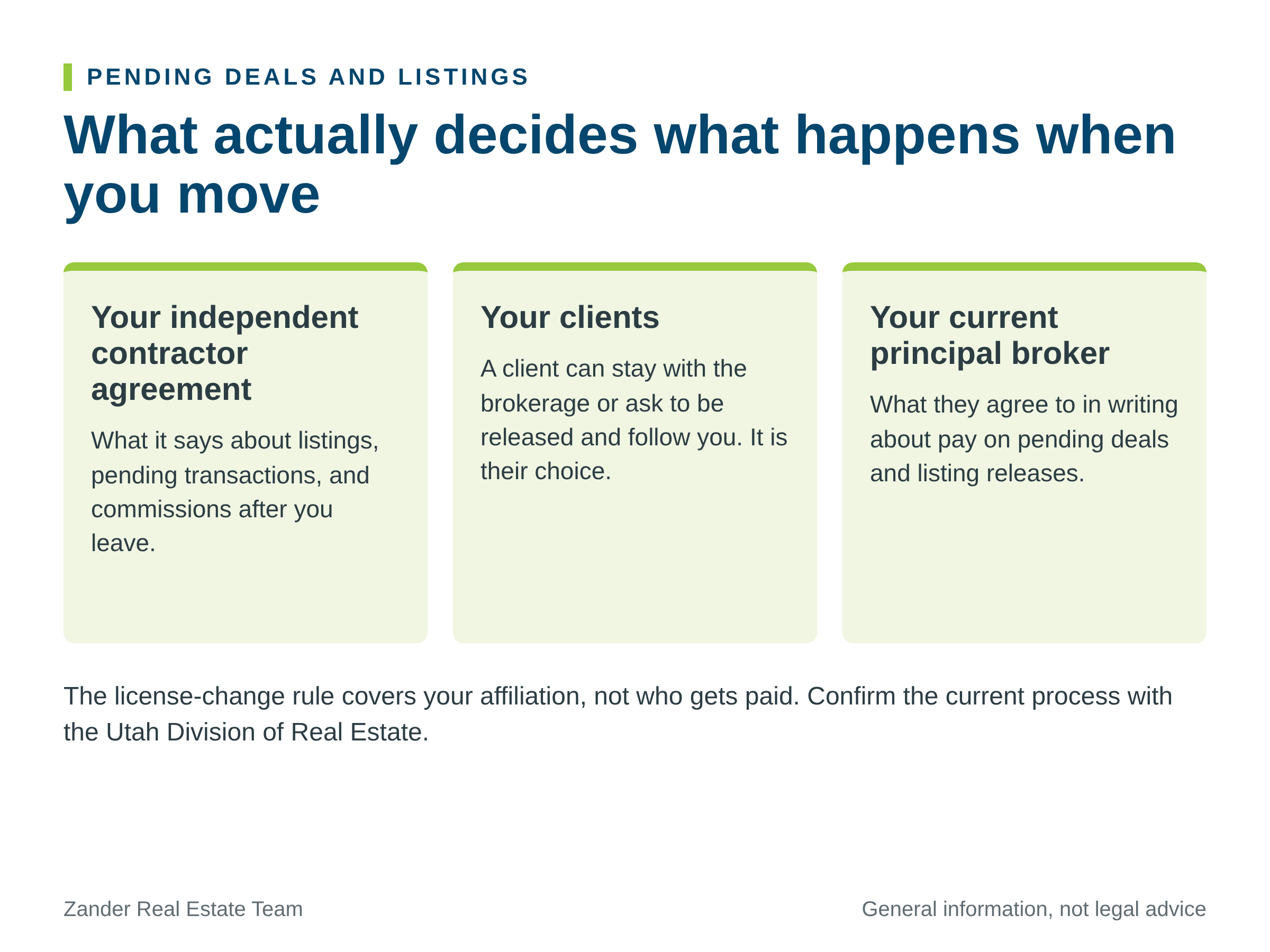
Review your brokerage agreement/contract, your client status, and with your broker when considering a switch
What should I read in my independent contractor agreement before I give notice?
Look for plain answers to these questions:
What happens to commissions on transactions that are under contract but not closed when I leave?
Who owns active listings, and is there a process to release them if the seller asks?
Is there a referral fee, transfer fee, or administrative fee on deals that close after I leave?
How much notice is required, and in what form?
Are there rules about contacting clients, or about marketing materials, signs, and lead data?
When are commissions disbursed, and to whom?
If the language is vague, that is useful information too. Vague terms are where disagreements start. I am not an attorney, so for anything unclear, a real estate attorney who reviews independent contractor agreements is worth a one-hour consultation.
What does the Utah Division of Real Estate require when an agent changes brokers?
The Division handles a change of principal broker through its online licensing system. Utah's administrative rule on reporting changes, R162-2f-207, says a change in affiliation must be reported to the Division before the change is made, and it describes how the agent and the brokers confirm the change. The rule also describes fallback notice methods if the former broker cannot be reached. Because the Division's forms and rules are updated from time to time, I will not walk you through exact filing steps here. Confirm the current process with the Utah Division of Real Estate before you act.
One point worth noticing: that rule covers your license and affiliation. It does not address who gets paid on a pending deal or who holds a listing. Those answers come from your agreement and from the people involved, which is why the paperwork review comes first.
How do I time the move around active closings?
There is no perfect moment, but there are smarter ones. Here is the sequence I suggest to agents who ask me:
Step 1: Make a deal inventory. List every active listing, every buyer under contract, every pending closing, and every scheduled closing date. Include inspection, due diligence, financing, and appraisal deadlines so you can see which files are fragile.
Step 2: Decide what should close where. For deals closing in the next two to three weeks, many agents choose to let them close at the current brokerage and move afterward. For listings with months left, you may need a conversation with the seller and your current broker about a release. Neither is automatically right. It depends on your agreement and your clients.
Step 3: Get any agreement in writing. If your principal broker agrees to pay commission on pending deals, release a listing, or waive a fee, ask for it in an email or signed document. A verbal "we will take care of you" is hard to rely on three months later.
Step 4: Talk to clients honestly and early enough. Clients under contract care about one thing: will the transaction close smoothly. Tell them what is changing, what is not, and who to call. Do not pressure anyone to move their contract. Let them choose.
Step 5: Plan the first week at the new place. Your new brokerage should be able to tell you how transaction coordination, signing tools, your CRM data, and your marketing will be set up so you are not rebuilding while you are also working.
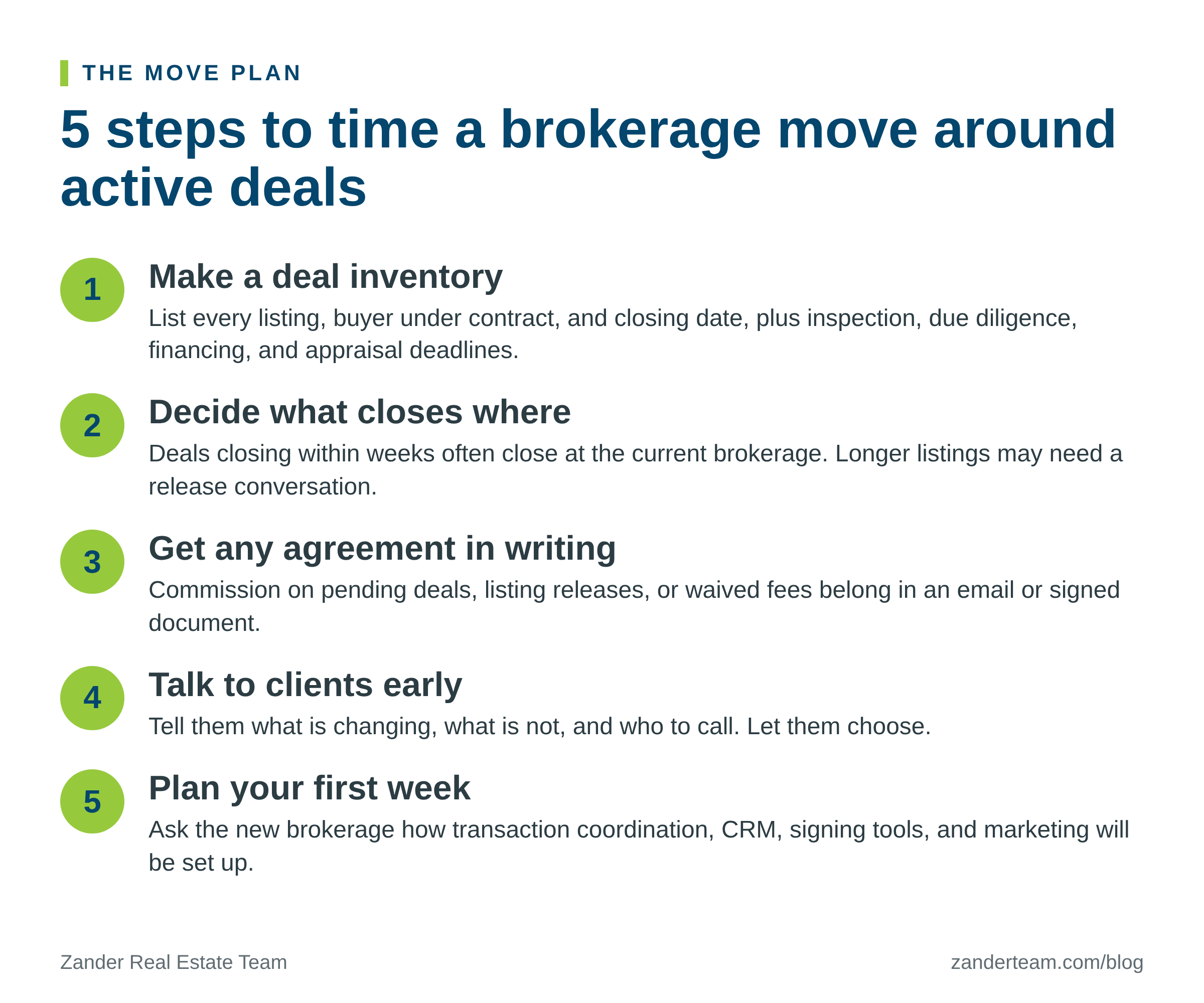
Five steps to time a brokerage move around active deals
What if I am not on great terms with my current broker?
Stay professional and keep everything in writing. The REALTOR Code of Ethics asks members to be truthful and not to disparage other brokers, and that is also just good strategy: you will see these people at closings, in the MLS, and across the table for years. Say what you need, thank them for what they gave you, and keep the tone boring. A calm exit protects your clients' deals better than a dramatic one.
What should I ask a new brokerage before I commit?
If you are going to move, the new team should be able to answer these without hedging:
What are the fees, and what is the cost to join?
How will lead flow work in my first 90 days, and what is expected of me?
What training and accountability exist, and are they required?
Who handles transaction coordination, and how are my in-progress files handled during the transition?
Is the agreement an independent contractor agreement, and can I read it before I decide?
What does leaving look like later? Ask this one on the way in.
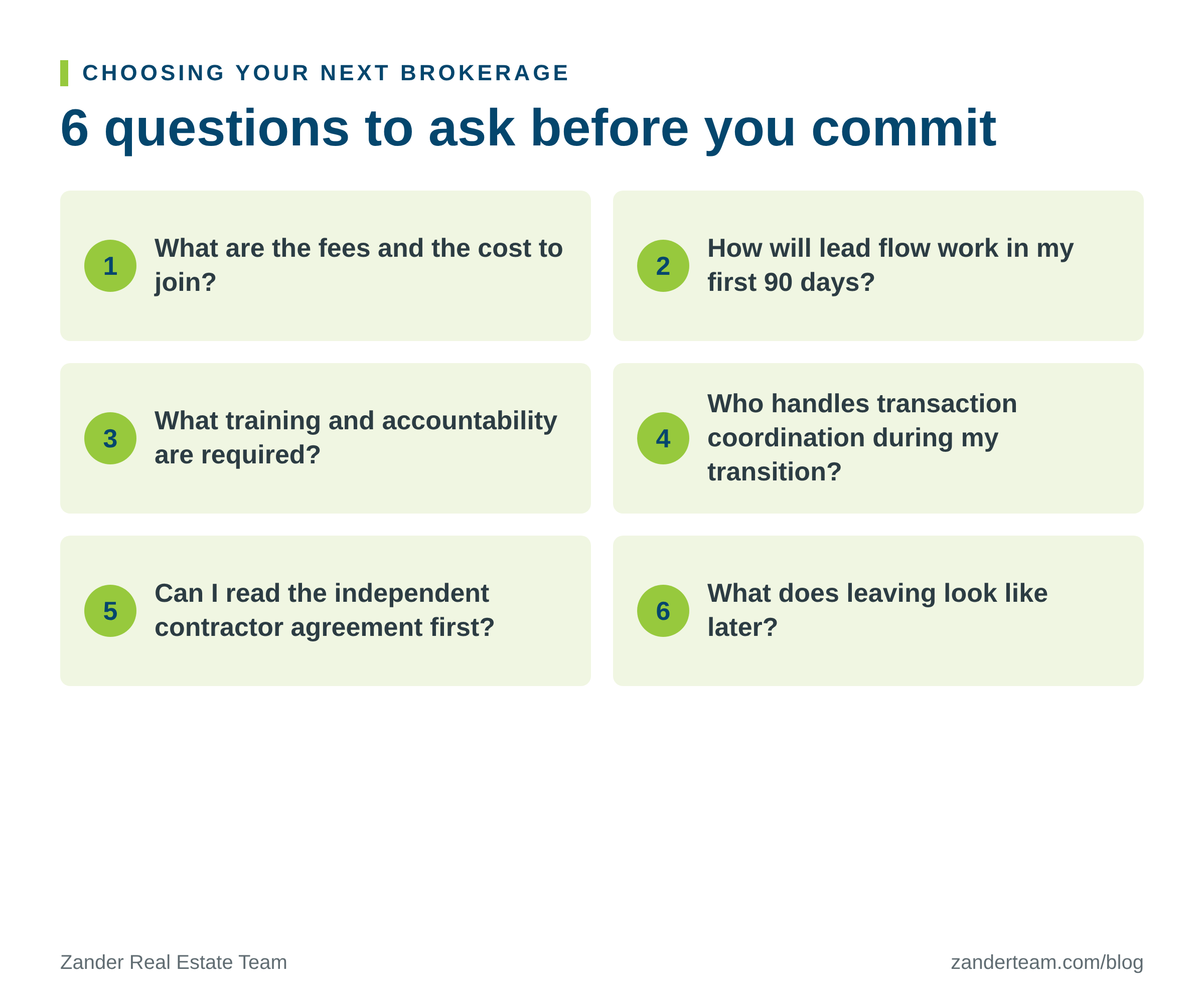
Questions to ask before switching brokerages
At Zander Team there is no fee and no cost to join, and we have a reputation we care about: a 4.9 Google rating and nearly 500 five-star reviews. We invest over $150k a year per agent in leads, marketing, coaching, and support, and our model is built around the idea that agents are not under-producing, they are under-equipped. I will say plainly that a team is not right for everyone. If you want full independence and no accountability, we are probably not your fit, and I would rather tell you that on the first call.
For more on how we run things, see How Our Real Estate Team Holds Agents Accountable Every Week and Why Daybreak Agents Choose a Locally Owned Brokerage. If your question is about economics, Is a Lower Commission Split on a Team Worth It in Utah? covers that in depth.
A simple pre-move checklist
Pull and read your independent contractor agreement.
Build your deal inventory with every deadline and closing date.
Ask your principal broker in writing how pending deals and listings will be handled.
Confirm the current license-change process with the Utah Division of Real Estate.
Talk with affected clients and let them choose.
Ask the new brokerage how your first 30 days will work.
Move on a date that gives your most fragile files the least risk.
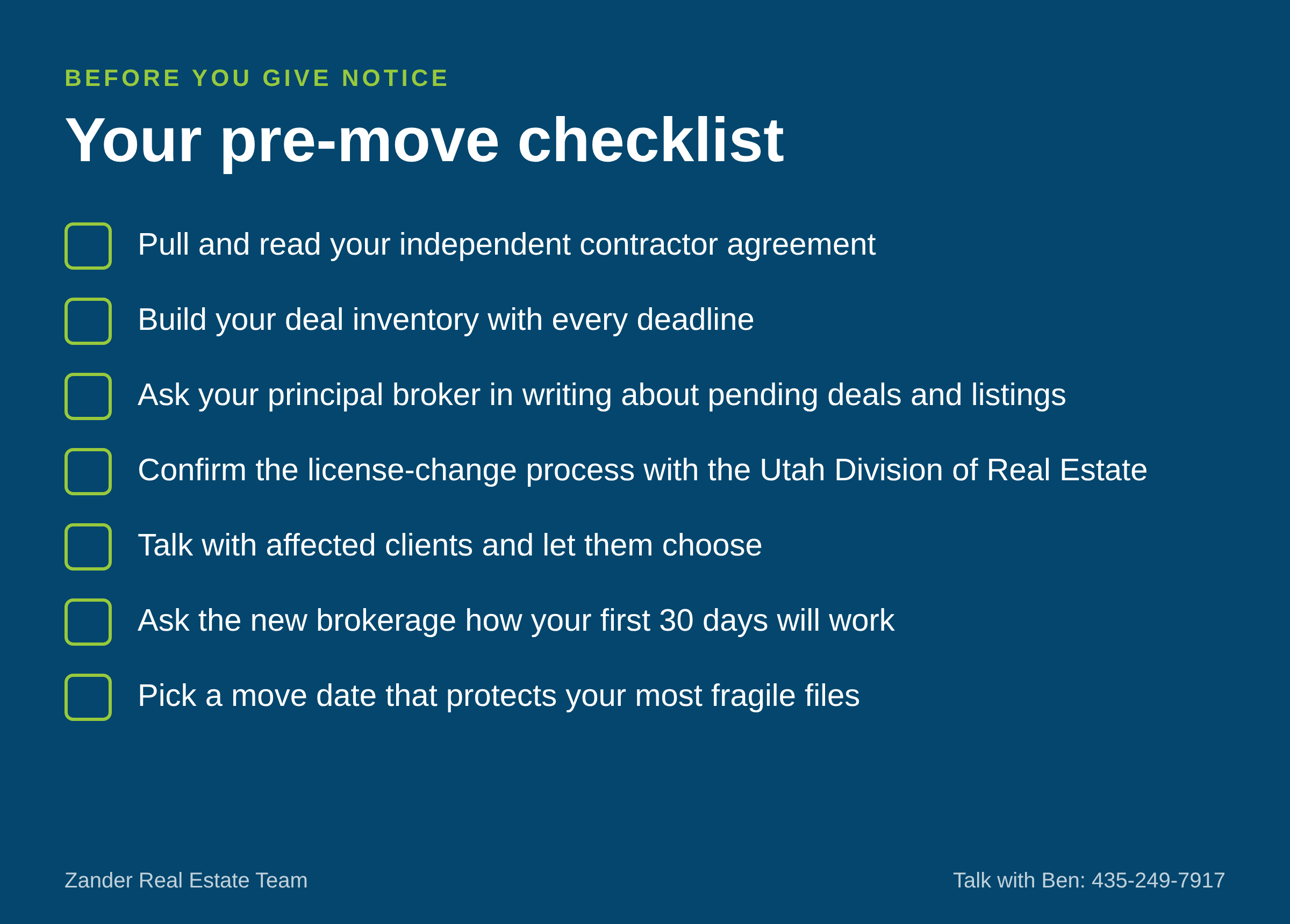
Things to do before switching brokerages
Frequently Asked Questions
Can I take my listings with me when I switch brokerages in Utah?
Not automatically. A listing agreement is generally with the brokerage. Whether a listing can move depends on your independent contractor agreement, your current broker's agreement to release it, and the seller's wishes.
Will I still get paid on deals that are under contract when I leave?
It depends on your agreement and on what your current broker agrees to. Ask in writing before you give notice, and keep a copy.
Do I have to tell the Utah Division of Real Estate before I change brokerages?
Utah's rule on reporting a change of information says a change in affiliation is reported to the Division before the change is made. Because processes get updated, confirm current steps with the Utah Division of Real Estate.
Should I wait until my pending deals close before switching?
Many agents time the move around closings, especially ones within a few weeks. Others negotiate a transition on longer listings. The right choice depends on your agreement and your clients.
Is it normal for agents to switch brokerages?
Yes. Agents move for support, lead flow, training, culture, and economics. The goal is to move in a way that protects clients and your reputation.
Talk with Ben
If you're weighing a move and want to see how this works in practice, grab time with me on my calendar or text me at 435-249-7917. If it's not a fit, I'll tell you.
This article is general information, not legal advice. Review your own agreements with a qualified attorney and confirm licensing requirements with the Utah Division of Real Estate.