Is a lower commission split on a real estate team worth it?
It can be, if the team saves enough time and adds enough value to cover the difference. Compare take-home pay, not the split: your gross commission per deal, times your split, minus your costs, times the deals you realistically close. In the example below, a 60% team split matches an 85% solo split once you close about 11.3 deals instead of 10. Ask any team to put its split schedule, fees, and lead rules in writing before you decide.
By Ben Zander, Agent Growth & Success | October 30, 2026
Agents ask me some version of this question more than any other: "Why would I give up a bigger split?" It's a fair question, and the answer is not "teams always win." Sometimes the higher split is the better deal. The only way to know is to compare what you take home, not the percentage on the agreement.
A split is a percentage of a number you haven't closed yet. The real question underneath it is how many more closings a team brings you, and what each closing costs you to produce.
For context, RISMedia's 2023 Contract & Commission Study found that agents and commission-earning brokers kept an average of 70% of their commission nationally. The 22% who were on a team paid an average of 34% to the team leader. That is national data from 2023, and what you are offered in Utah can look different, so treat it as a reference point and not a promise.
The break-even math
Use this formula:
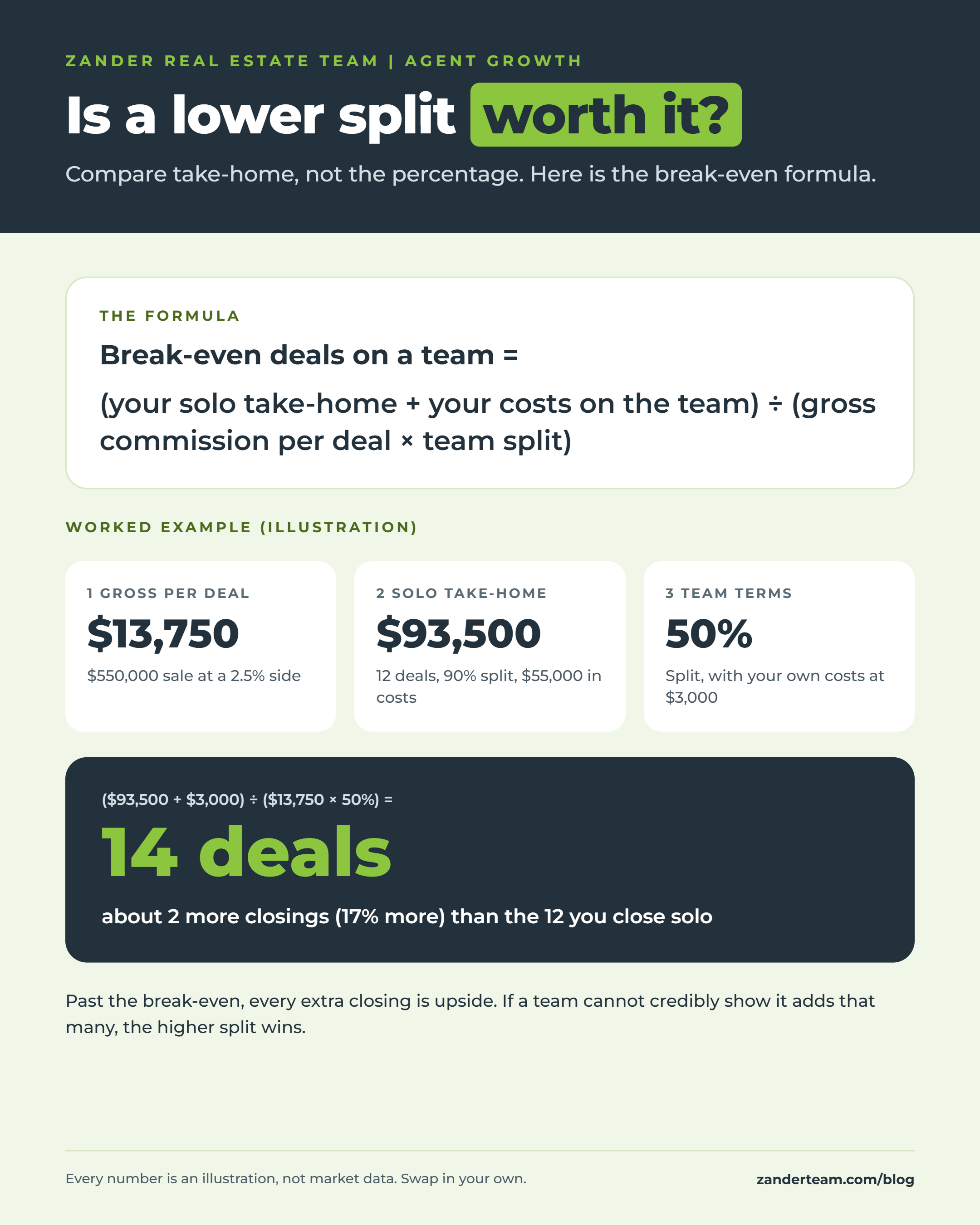
Break-even deals on a team = (your solo take-home + your costs on the team) ÷ (gross commission per deal × team split)
Here is a worked example. Every number is an illustration, not market data. Swap in your own.
Gross commission per deal: a $550,000 sale at a 2.5% side is $13,750.
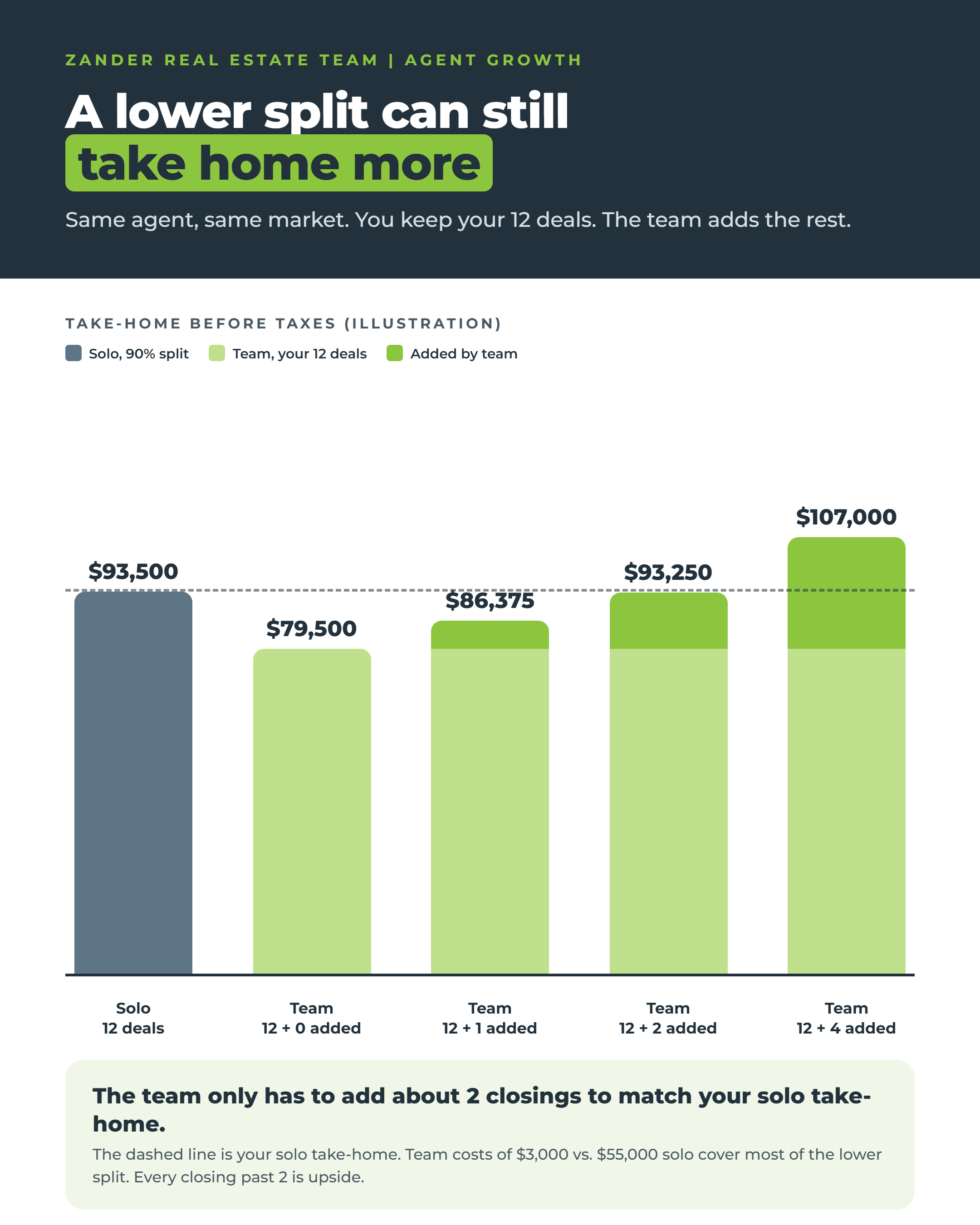
Solo: a 90% split, 12 deals, and $55,000 a year in costs for marketing, CRM and lead tools, transaction coordination, photography, client gifts, signs, and insurance. Take-home before taxes is 12 × $13,750 × 90% = $148,500, minus $55,000, which leaves $93,500.
Team: a 50% split, and your own costs drop to $1,000 because the team covers marketing, admin, leads, and tech. Break-even is ($93,500 + $3,000) ÷ ($13,750 × 50%) = about 14 deals.
In this example, the team has to add roughly 2 closings a year, about 17% more than you close alone, to match your solo income. Every closing past that is upside. If the team can't credibly show it adds that many, the higher split wins.
Agents who already run lean need a team to add more.
Two questions turn this from a guess into a decision. How many team leads convert into closings for an agent at your production level? And how long does it take from your first day to your first closing? Ask for ranges, not the best case.
Five things to get in writing before you join a team
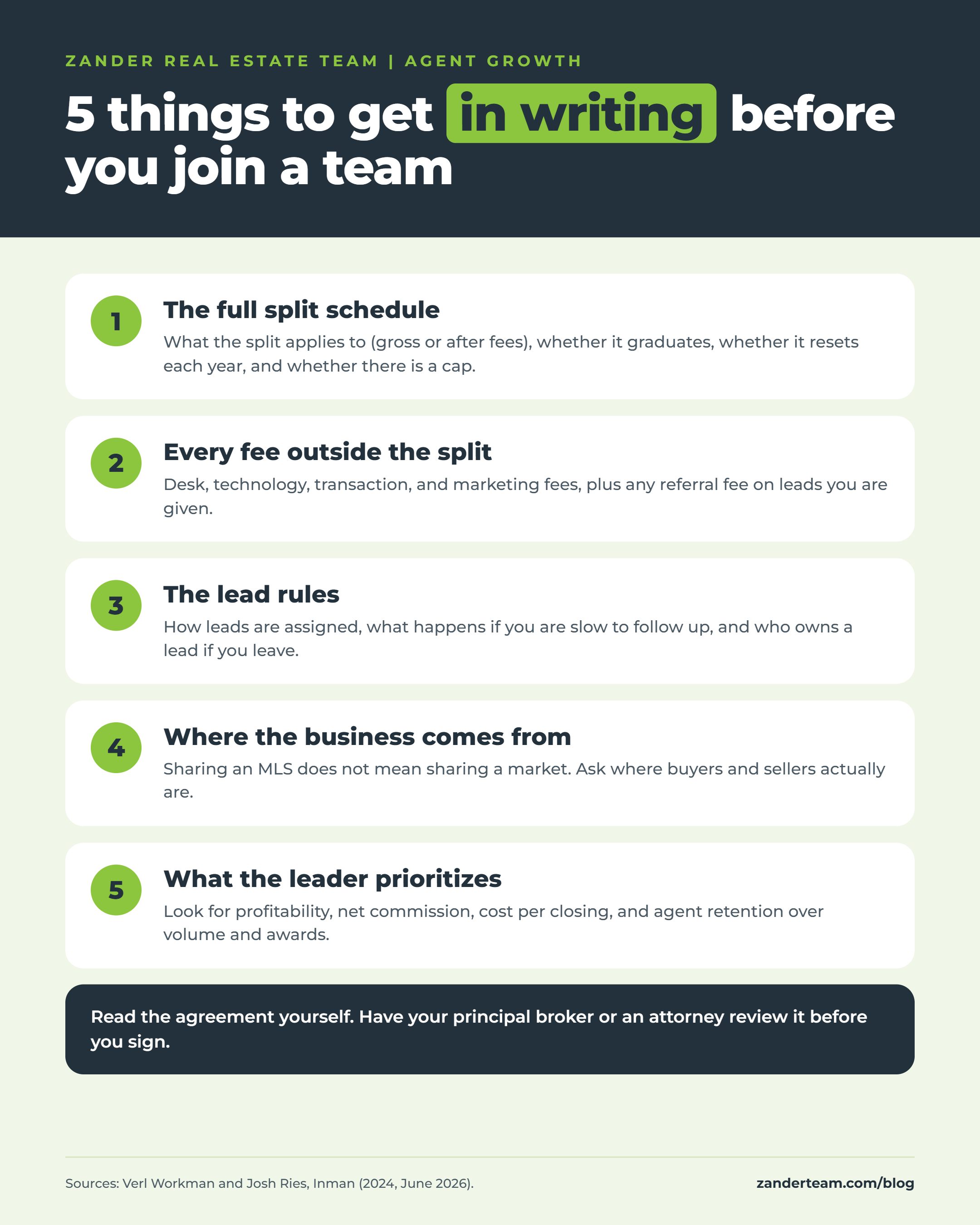
The full split schedule. What the split applies to (gross commission or after fees), whether it graduates as you produce, whether it resets each year, and whether there is a cap.
Every fee outside the split. Desk, technology, transaction, and marketing fees, plus any referral fee on leads you are given. Brokerage model matters here too, since franchise fees come out of different places. We walked through that trade-off in why Daybreak agents choose a locally owned brokerage.
Lead rules. How leads are assigned, what happens if you are slow to follow up, and who owns a lead if you leave. Team leader Verl Workman, writing in Inman, names unfair lead sharing as a sign of an unhealthy team.
Where the business comes from. A team can share your MLS, UtahRealEstate.com, and still do most of its business far from where you want to work. Josh Ries makes this point in his June 2026 Inman piece on five questions to ask before joining a team.
What the leader prioritizes. Ries suggests looking for profitability, net commission, cost per closing, and agent retention, and being wary of leaders who talk mostly about volume and awards.
Read the team agreement yourself, and have your principal broker or an attorney review it before you sign. As independent contractors, agents handle their own self-employment taxes, so run these numbers past your CPA too.
One Utah detail is worth knowing. Under Utah's advertising rule, a team is held to the same advertising requirements as an individual licensee, including clearly identifying the brokerage, and the name has to match the one on the Division's records. If a team's marketing buries the brokerage name, ask why.
On our team, we bring in 250+ new leads a month and an inside sales team sets appointments. That is the kind of claim I would want any team, including ours, to back with conversion data for an agent at your level. If you want to see how we hold agents to their goals, here is how our weekly accountability meeting works.
When staying solo is the better call
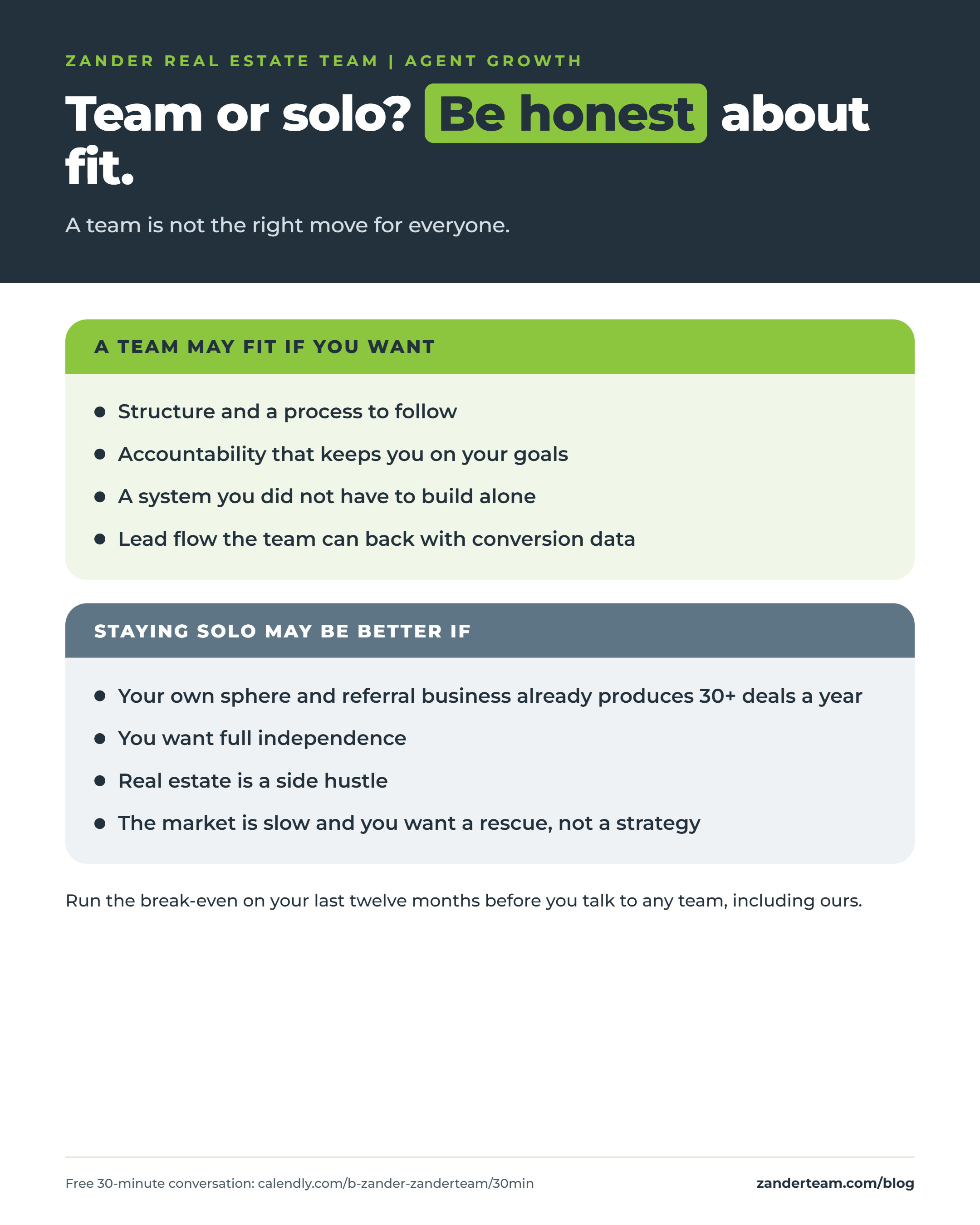
A team is not the right move for everyone, and I would rather say so up front.
Your own business already produces 20+ deals a year. If repeat and referral business carries you past that, a team's lead flow probably adds less than the split costs you.
You want full independence. A team asks you to follow a process, report your activity, and show up for training. If that sounds like a cost and not a benefit, a team will feel expensive at any split.
Real estate is a side hustle. Teams built around daily activity and accountability work best for agents who are all in.
The market is slow and you want a rescue. Ries cautions against joining a team just because the market is slow. A team should support a clear strategy, not stand in for one.
Frequently Asked Questions
What is a normal commission split for a real estate team?
There is no single normal. RISMedia's 2023 national study found team members paid an average of 34% to the team leader, but structures vary widely with graduated splits, caps, and fees. Ask for the written schedule, and compare it using take-home pay.
Is a higher split always better?
No. A higher split on fewer closings can net less than a lower split on more closings. A lower split with costs covered by the team can also beat a higher split with every expense on your side. Run the break-even for your own numbers.
What fees should I ask about besides the split?
Ask about desk fees, technology and marketing fees, per-transaction fees, caps and what counts toward them, and any referral fee on leads the team provides. Ask what each fee covers and when it resets.
Can I leave a team if it isn't working?
Yes, but read your agreement first, especially the terms on leads, referrals, and pending deals. In Utah, a change of principal broker is reported through the Division of Real Estate and must be reported before it takes effect, so confirm the current process with the Division. Moves are common: in NAR's October 2026 report, 34% of firms said a departing licensee had resigned to join another real estate company.
How does the Zander Team compare with other teams and brokerages?
The Zander Team is an independent brokerage that operates as a team, which means there are no ‘team costs’ on top of your commission split. Our brokerage offers agents over $100k in value each with no resource or office fee. We provide 60% more closing opportunities for our agents and help our agents average 0.41% higher commission earnings than Utah’s average.
The takeaway
The right split is the one that leaves you the most take-home at the number of closings you can actually produce. Run the break-even on your last twelve months before you talk to any team, including ours. A team fits agents who want structure, accountability, and a system they didn't have to build alone. It may not be a fit for agents who want full independence or who get 30+ deals a year from their own sphere and/or referrals.
If you want a second set of eyes on your math, grab 30 minutes with me on my calendar or text me at 435-249-7917. No pressure. If it's not a fit, I'll tell you.
About Ben Zander
Ben has education in psychology, human resources, and business with experience in local, international and fortune 500 companies. He is over Agent Growth & Success at Zander Real Estate Team in South Jordan, Utah. Currently Ben leads agent training & coaching, lead opportunities, business partnerships, and agents wanting to join the brokerage.